Phase I feasibility work for a coordination infrastructure that stabilizes small-farm income without raising buyer costs.
Overview
Fruitful Network Development is building a practical business model around website hosting and operational support for farms and local food organizations. The offer is intentionally straightforward: price-match common website subscriptions (such as Wix and Squarespace tiers), deliver a better-fit operating setup, and keep total cost predictable for small teams.
For general readers, the core value is not abstract. Clients are paying a familiar monthly price for tangible improvements in reliability, integrations, payments, and workflow fit. In parallel, they are supporting an open, continuously improving toolchain rather than a closed platform that depends on lock-in to sustain itself.
The open-source component remains practical: development continues at price-matching rates because the architecture is modular and reusable across implementations. Outside normal agreements, additional costs apply only when underlying usage materially changes, primarily through unusually large data storage or bandwidth demand.
If readers want deeper context on why this model is structured this way, the detailed rationale is covered in Services and long-form material in Read More.
For Agriculture
Every year, the US economy loses out on $70B in output that small farm could have output. Meanwhile, monocrop agriculture and harmful practices costs the US $2.2T
Our mission is to eliminate these damages and these losses. Allowing local economies to be the center of communities again.
For Farmers
Small farms make up 90% of the US farmland and simultaneously profit 10% less/per acre than industrial farms; even despite less waste.
Farmers can't plan to produce what they don't know they'll be able to sell.
The demand, the people, and the product are all there; it's the coordination that's broken.
For Consumers
Since local farms can't capitalize on their full potential, our food system can only stock products affordably from industrial farms.
We're building a world where individuals aren't barred from buying healthy local produce — in logistics or cost.
Recovered Production Opportunity
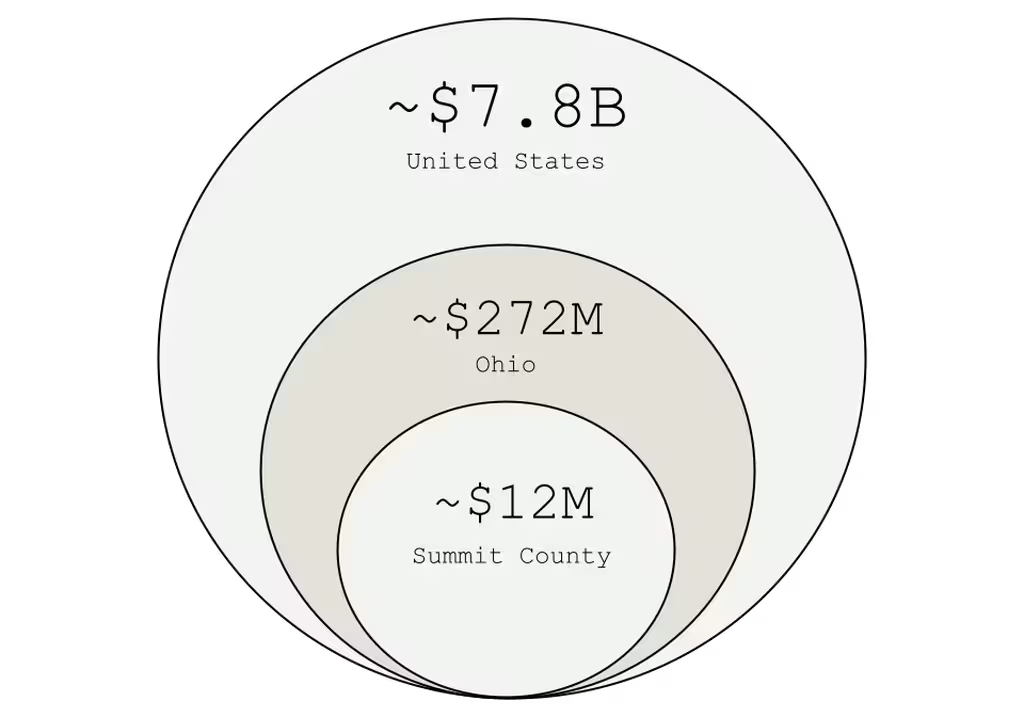
Phase I market framing treats produce recovery as a bounded commercialization target, not an abstract macro claim. The purpose is to measure where local coordination can convert currently unrealized output into stable, purchasable supply.
TAM: National produce demand baseline and substitution window.
SAM: Regional radius where adjacency and cold-chain timing remain feasible.
SOM: Early adoption wedge reachable with existing partner farms and hubs.
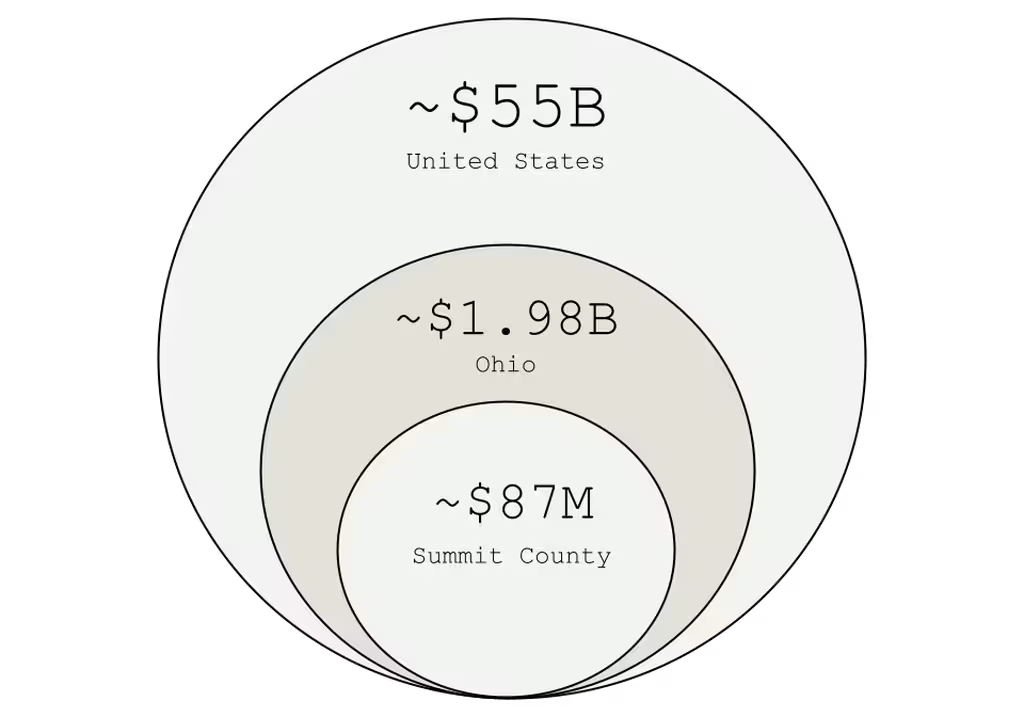
Recovered Loss from Waste and Friction
Waste and overhead are treated as measurable market leakage. Coordination value comes from reducing avoidable shrink, routing inefficiency, and fragmented ordering overhead while preserving producer-side margins.
Fresh produce loss bands are high enough to justify a dedicated coordination intervention.
Distance and timing windows are modeled as hard constraints, not optional assumptions.
Scenario outputs prioritize delivered cost parity and reliability over purely theoretical yield gains.
Demand and Localization Signals
Market demand is treated as present but structurally under-expressed. The commercialization question is whether the system can convert preference into repeatable procurement behavior through better coordination and clearer service reliability.
Local preference exists, but definition and radius vary by buyer context.
Pilot scope emphasizes realistic service radii, not universal replacement of industrial channels.
Buyer adoption is tied to parity + reliability, not narrative alignment alone.
The market model is grounded in deployable regional artifacts: farm supply bands, hub demand profiles, and route adjacency geometry. These artifacts allow feasibility to be simulated and then tested operationally.
Capacity bands from interviews and acreage-informed planning assumptions.
Buyer demand profiles with service floors and cost tolerance bands.
Network geometry for route density and service-radius viability.
Broader health and environmental costs are treated as contextual support rather than direct Phase I success criteria. Phase I remains focused on two-sided feasibility and operational adoption thresholds.
Primary decision metric: can farms improve while buyers avoid degradation?
Secondary context: large externalized costs strengthen long-run relevance.
The market analysis output is a bounded feasibility dossier that links scenario assumptions to adoption-ready operations. This section supports that dossier with reusable artifacts for simulation, pilot scoping, and stakeholder review.
Scenario bands for demand, waste/shrink, and routing costs.
Feasible radius and basket definitions for pilot commitments.
Transition notes from current output to credible capacity bands.
Transitional Feasibility: The Economic Case for Local Agriculture at Scale
This page explains the reasoning behind a single claim:
Local agriculture can become cost-competitive with industrial, mono-crop supply chains once coordination reaches a critical adoption threshold—because coordination collapses risk, reduces avoidable overhead, and stabilizes utilization.
The purpose here is not to sell a story. It is to define the research setting, identify the binding constraint (coordination failure), and show why the problem reduces to a window of feasibility and a critical adoption point.
1) Exogenous and Endogenous Research Setting (System Boundary)
Exogenous conditions (treated as fixed in Phase I scenarios)
Demand signal exists: consumers prefer local, sustainable, and lower-chemical produce; however, that preference is not reliably expressed through procurement because local supply is not consistently accessible.
Industrial alternative exists: grocers can procure from established distributors with known pricing, service levels, and cold-chain logistics.
Cost structure of industrial supply: long-distance refrigerated transport, centralized handling, and structural waste are embedded in the baseline supply chain; Phase I treats these as cost bands.
Geography and seasonality: farms and buyers are spatially distributed; perishability creates time windows; availability is seasonal.
Endogenous variables (what changes when coordination improves)
Sell-through certainty (percentage of viable output sold within a time window)
Farm income volatility (operational axis; e.g., margin CV or probability of loss-months)
Waste/shrink (unsold or spoiled product share)
Delivered cost per unit to hubs/grocers (all-in delivered cost)
2) The Binding Constraint: Coordination Failure as the Source of Risk
In many regions, demand exists but does not translate into reliable procurement because the system lacks stable interfaces, dependable service levels, aggregation capacity, visibility, and commitment mechanisms.
When farms operate as isolated suppliers, conservative planting underutilizes capacity while aggressive planting increases spoilage risk. This is coordination failure at the system level.
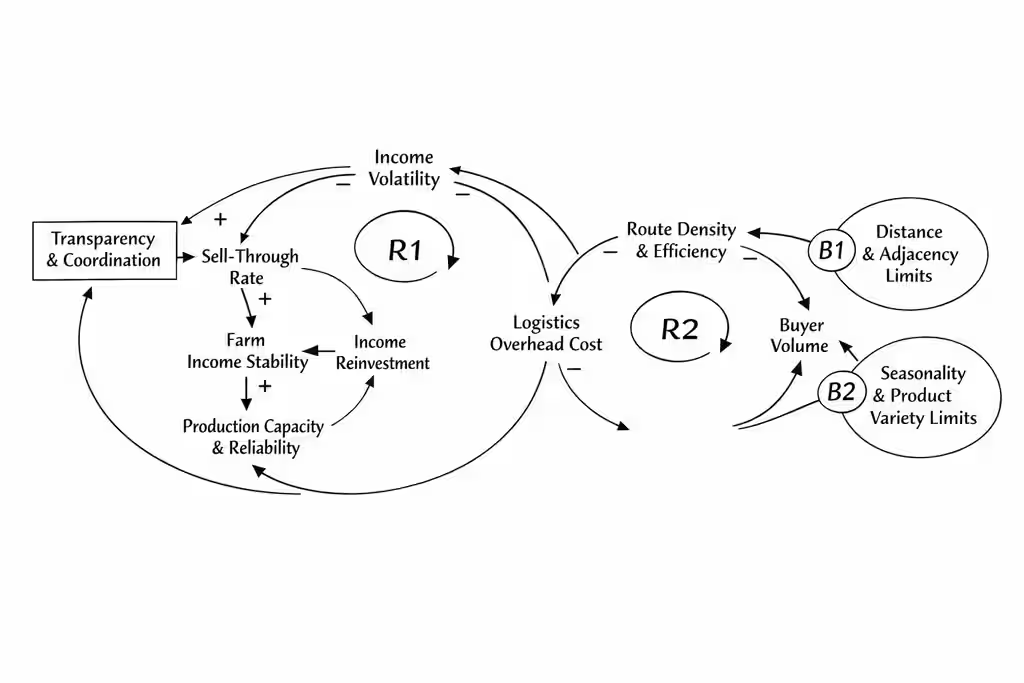
A causal loop with income stability and cost compression loops, bounded by adjacency, seasonality, cold-chain, and handling throughput constraints.
3) The Window of Feasibility: Two-Sided Profitability as the Real Gate
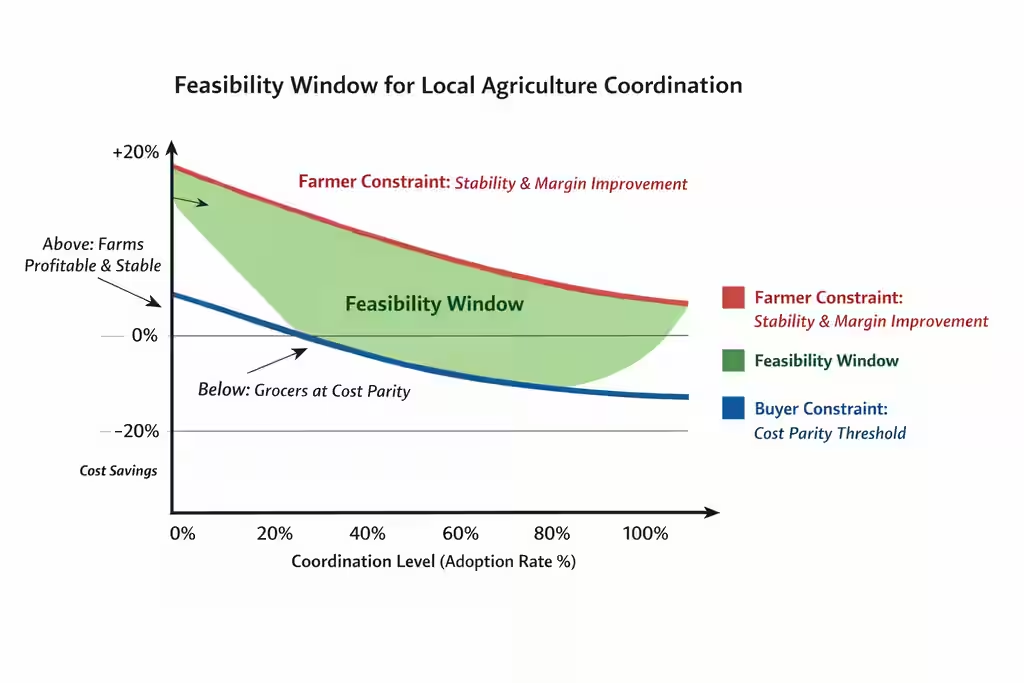
Coordination matters only if both sides benefit: farms must improve and hubs/grocers must not worsen. The key question is whether a feasible region exists where producer economics and buyer economics work simultaneously.
Figure B — Feasibility Window for Two-Sided Gains.
A shaded region where buyer-side cost/service constraints and farmer-side volatility/margin constraints intersect. Critical adoption occurs when coordination moves into this region.
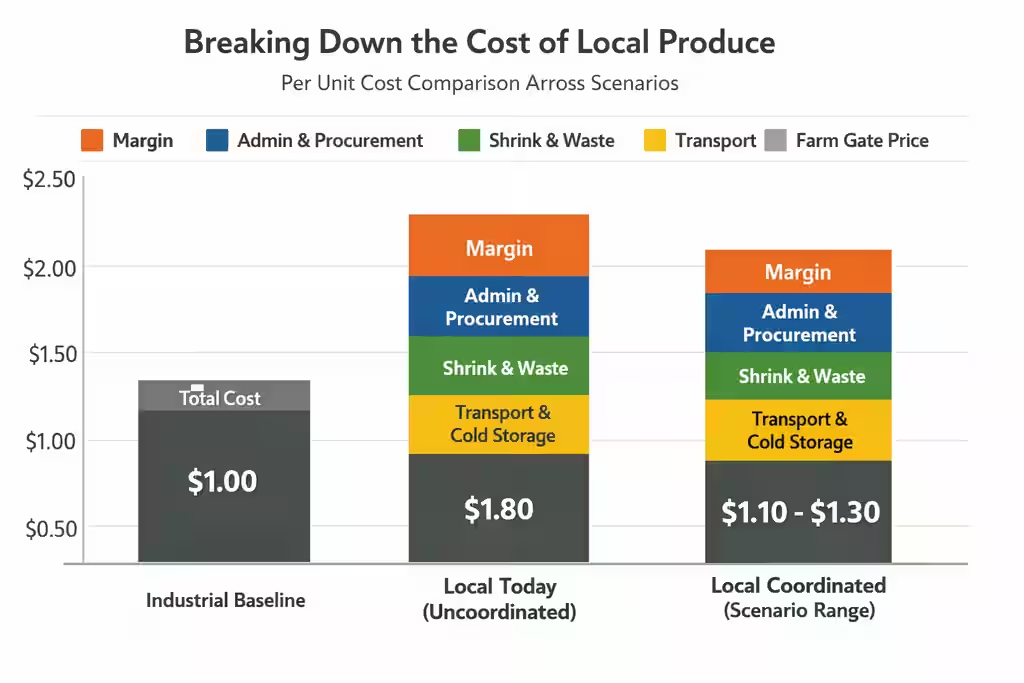
4) Where the Cost Gap Comes From (and What Coordination Actually Removes)
Local appears expensive when fragmentation drives low-utilization logistics, procurement friction, waste/shrink, and weak commitment for planning. Coordination shifts the cost basis by reducing avoidable overhead and improving utilization without forcing loss of autonomy.
Figure C — Delivered Cost Stack: Industrial vs Local (Uncoordinated) vs Local (Coordinated Scenario Bands).
Stacked components (transport, handling, waste/shrink, procurement overhead, margin) showing where measurable compression must occur.
5) Geography and Variety: The Real Limits (and Why That’s Still Enough)
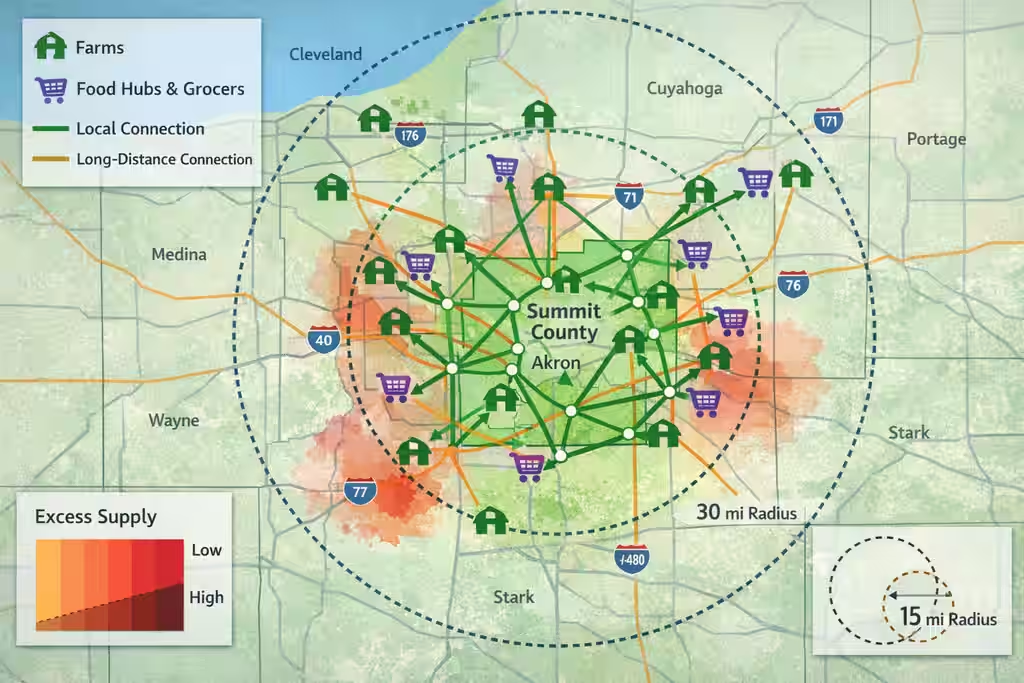
The claim is bounded: within a service radius and product basket, local can become the dominant economic option after crossing a coordination threshold. Distance adjacency and basket completeness are hard constraints, and that is exactly what makes the feasibility study testable.
Figure D — Map of Adjacency: Farms, Hubs, Demand Nodes, and Service Radii.
A network map with nodes and weighted edges by distance/time cost, highlighting where coordination can and cannot plausibly reduce overhead.
6) Transitional Feasibility: Capacity Bands, Not Agronomic Optimization
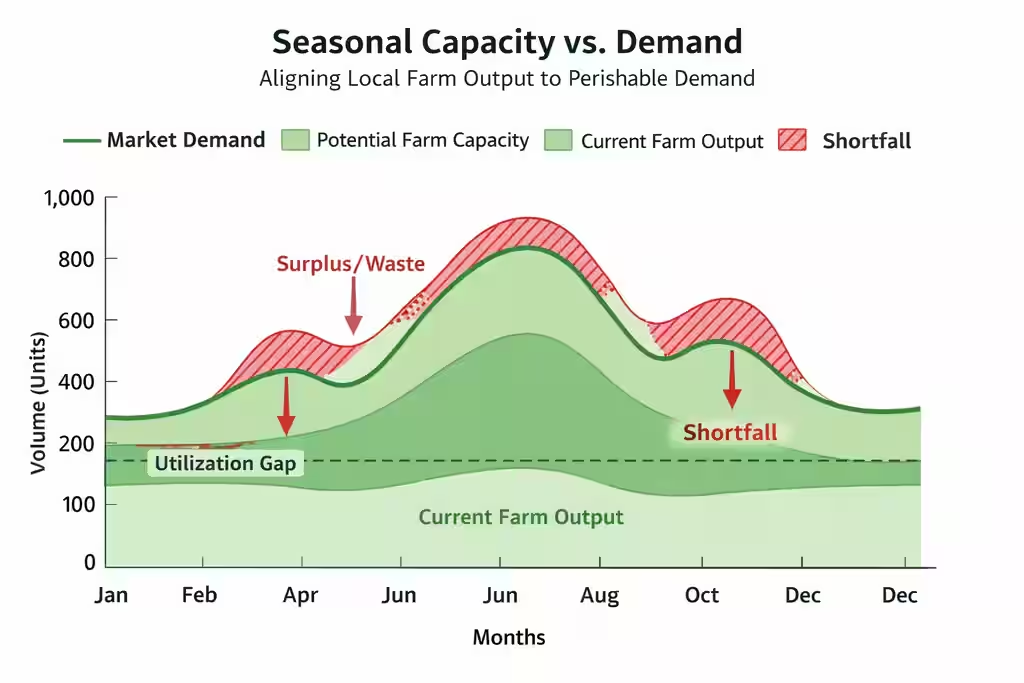
Phase I does not attempt biophysical yield optimization. It uses interview-informed current output and farmer-validated acreage/planning assumptions to establish capacity bands and estimate the production gap under improved sell-through certainty.
Figure E — Seasonal Supply vs Demand: Current Output Band vs Capacity Band.
A time series comparing demand against current and plausible capacity bands, identifying mismatch windows and transition feasibility across seasons.
7) Why Digital Infrastructure Is the Enabler (Without Requiring Central Control)
Local systems require coordination without forced consolidation. Shared interpretability and policy-aware interoperability can coordinate distributed entities while preserving autonomy.
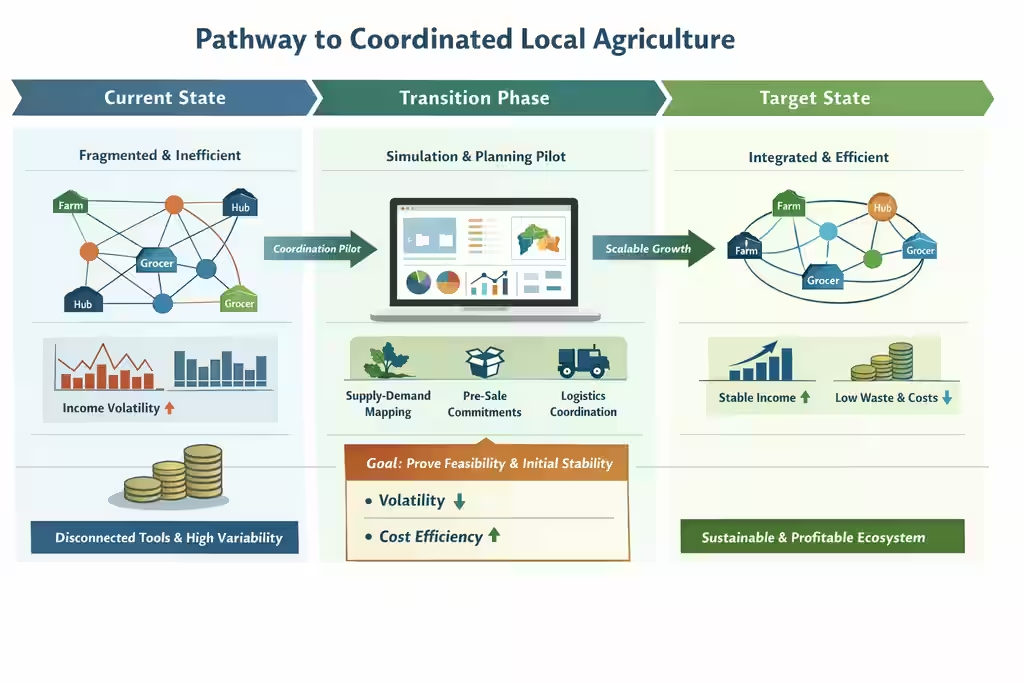
Figure F — Transition Pathway: Adoption Wedge to Coordination Layer to Brokerage Operations.
A staged pathway linking immediate operational tooling value to interoperability and subsequent brokerage workflow activation after the feasibility window is demonstrated.
8) What Phase I Must Establish (and What Would Falsify the Claim)
Phase I succeeds if a plausible region exists where farms reduce volatility, buyers meet cost/service constraints, and a transition from current output to capacity bands is credible over a bounded horizon.
Phase I fails if no feasible window exists under realistic assumptions, if feasibility requires implausible overhead reduction, or if one side must absorb persistent losses.